



Introduction
Hearing the words “low sperm count” can feel overwhelming for many couples trying to conceive. You may wonder: Does this mean natural pregnancy is impossible? Are there still options available?
The good news is that modern fertility treatments—especially In Vitro Fertilization (IVF)—have made parenthood possible for thousands of couples facing male infertility.
Think of conception like planting a seed in a garden. If the seed supply is limited or weak, growing a plant naturally becomes harder. But with the help of advanced medical technology, doctors can select the healthiest seeds and place them exactly where they need to grow. That’s essentially how IVF works when sperm count is low.
In this guide, we’ll explore how IVF works for low sperm count, treatment options, success rates, and why consulting the best IVF doctor in New Delhi can make a significant difference.
1. What Does Low Sperm Count Mean?
Low sperm count, medically called oligospermia, occurs when the semen contains fewer sperm than normal.
According to medical guidelines:
Normal sperm count: 15 million sperm per milliliter or more
Low sperm count: Less than 15 million sperm per milliliter
Sperm are responsible for fertilizing the egg. When fewer sperm are present, the chances of fertilization decrease.
But here's the encouraging part: even a small number of healthy sperm can lead to pregnancy with the help of IVF.
2. Common Causes of Low Sperm Count
Low sperm count can happen for many reasons. Sometimes it's due to lifestyle factors, while in other cases it may be related to medical conditions.
Common causes include:
Hormonal imbalance
Varicocele (enlarged veins in the testicles).
Genetic conditions.
Smoking and alcohol consumption.
Obesity.
Stress.
Exposure to toxins.
Previous infections.
Certain medications.
Understanding the root cause helps doctors decide the best treatment plan.
3. Symptoms of Low Sperm Count.
Many men with low sperm count don't notice any symptoms until they try to conceive.
However, some possible signs may include:.
Difficulty getting a partner pregnant.
Low sex drive.
Erectile dysfunction.
Pain or swelling in testicles.
Reduced facial or body hair.
In most cases, a semen analysis test is the only way to confirm the diagnosis.
4. How Low Sperm Count Affects Fertility.
Fertilization is a bit like a race. Millions of sperm start the journey toward the egg, but only one succeeds.
If sperm numbers are low, the odds of reaching the egg drop significantly.
Imagine trying to win a lottery with only a few tickets while others have thousands. The chances shrink-- but they don't disappear completely.
This is where IVF and advanced techniques step in to improve those chances.
5. Can Pregnancy Happen Naturally with Low Sperm Count?
Yes, natural pregnancy is still possible, especially when the sperm count is only slightly below normal.
However, chances depend on:.
Sperm motility (movement).
Sperm shape.
Female partner's fertility.
Timing of intercourse.
If pregnancy doesn't occur after 12 months of trying, fertility treatments like IVF may be recommended.
6. What Is IVF and How Does It Work?
In Vitro Fertilization (IVF) is a fertility treatment where fertilization happens outside the body in a laboratory.
The process involves:.
Stimulating the ovaries to produce eggs.
Retrieving eggs from the ovaries.
Collecting sperm samples.
Fertilizing eggs in a laboratory.
Transferring the embryo into the uterus.
IVF helps overcome many fertility challenges, including low sperm count.
7. How IVF Helps Couples with Low Sperm Count.
One of the biggest advantages of IVF is that it reduces the number of sperm required for fertilization.
Instead of relying on millions of sperm to reach the egg naturally, doctors can select healthy sperm directly in the laboratory.
Benefits include:.
Higher fertilization chances.
Better embryo selection.
Increased pregnancy success.
For many couples struggling with male infertility, IVF becomes a life-changing solution.
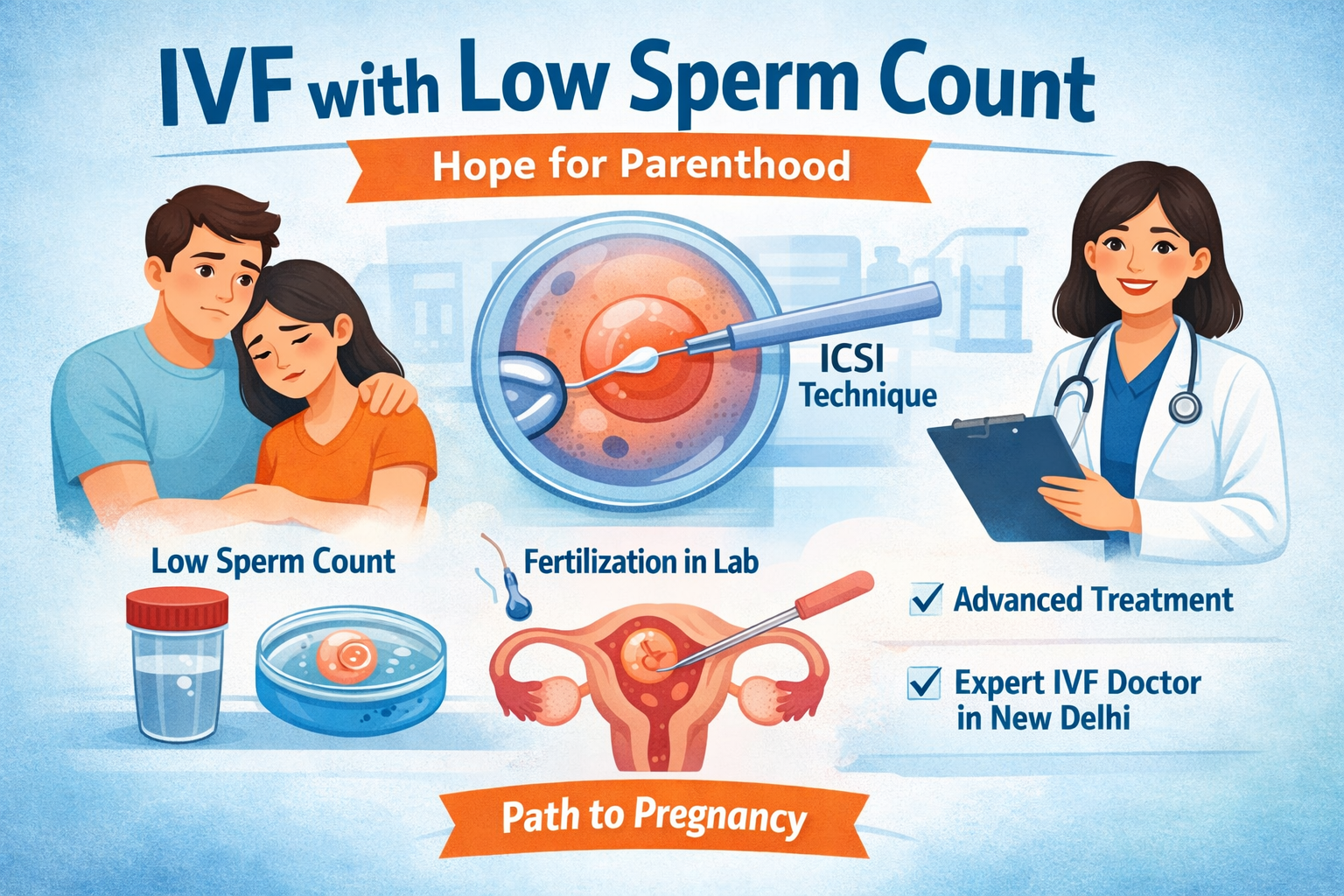
8. Role of ICSI in IVF Treatment.
One of the most important breakthroughs in fertility medicine is Intracytoplasmic Sperm Injection (ICSI).
In this technique:.
A single healthy sperm is injected directly into the egg.
This method is especially helpful when:.
Sperm count is extremely low.
Sperm movement is poor.
Previous IVF cycles failed.
ICSI dramatically improves fertilization rates in cases of severe male infertility.
9. IVF Procedure Step-by-Step.
Understanding the IVF process can make the journey less stressful.
Step 1: Ovarian stimulation.
Medications stimulate the ovaries to produce multiple eggs.
Step 2: Egg retrieval.
Doctors collect eggs through a minor procedure.
Step 3: Sperm collection.
Sperm is obtained through ejaculation or surgical retrieval.
Step 4: Fertilization.
Egg and sperm are combined in the lab (often using ICSI).
Step 5: Embryo development.
Embryos grow for 3-- 5 days.
Step 6: Embryo transfer.
Healthy embryos are placed into the uterus.
Two weeks later, a pregnancy test confirms the result.
10. Success Rates of IVF with Low Sperm Count.
IVF success rates depend on several factors:.
Female partner's age.
Egg quality.
Embryo quality.
Doctor's expertise.
Clinic technology.
On average, IVF success rates range between 40% to 60% per cycle for younger couples.
When performed by the best IVF doctor in New Delhi, success rates can improve due to advanced techniques and experienced medical teams.
11. Lifestyle Changes That Improve Sperm Health.
Before or during fertility treatment, lifestyle changes can improve sperm quality.
Helpful habits include:.
Maintaining a healthy weight.
Quitting smoking.
Limiting alcohol intake.
Managing stress.
Exercising regularly.
Eating antioxidant-rich foods.
Foods like nuts, fruits, vegetables, and fish support better sperm health.
12. Why Choosing the Best IVF Doctor in New Delhi Matters.
Fertility treatment is not just about technology-- it's also about experience and expertise.
An experienced fertility specialist can:.
Identify the exact cause of infertility.
Recommend the right treatment approach.
Improve IVF success rates.
Provide emotional support during the journey.
Consulting the best IVF doctor in New Delhi ensures access to modern laboratories, advanced fertility techniques, and personalized treatment plans.
13. Cost of IVF for Male Infertility.
The cost of IVF varies depending on several factors.
In India, the average IVF cycle may cost:.
1,20,000-- 2,50,000 per cycle.
Additional procedures such as ICSI, sperm retrieval, or embryo freezing may increase the cost.
Despite the expense, many couples see IVF as an investment in their dream of parenthood.
14. Emotional Support During Fertility Treatment.
The fertility journey can be emotionally challenging. Couples may experience:.
Anxiety.
Stress.
Frustration.
Fear of failure.
Talking openly with your partner, seeking counseling, and connecting with support groups can make the process easier.
Remember, fertility treatment is not just a medical journey-- it's an emotional one too.
15. When Should Couples See a Fertility Specialist?
You should consult a fertility doctor if:.
Pregnancy hasn't occurred after 1 year of trying.
The male partner has known sperm issues.
The female partner is over 35 years old.
There is a history of reproductive health problems.
Early consultation with the best IVF doctor in New Delhi can save valuable time and increase chances of success.
Conclusion.
Low sperm count may feel like a major obstacle when trying to conceive, but it doesn't have to end your dream of becoming parents. Thanks to advances in reproductive medicine, treatments like IVF and ICSI have opened new doors for couples facing male infertility.
With the right diagnosis, proper lifestyle changes, and guidance from the best IVF doctor in New Delhi, many couples successfully achieve pregnancy every year.
If you or your partner have been struggling with fertility issues, remember this: solutions exist, and hope is very much alive.
FAQs.
1. Can IVF work if sperm count is very low?
Yes. IVF combined with ICSI allows doctors to inject a single healthy sperm into an egg, making pregnancy possible even with extremely low sperm counts.
2. Is IVF the only treatment for low sperm count?
Not always. Some men benefit from medications, lifestyle changes, or procedures like IUI, depending on the severity of the condition.
3. How long does IVF treatment take?
A single IVF cycle usually takes 4-- 6 weeks, including ovarian stimulation, egg retrieval, fertilization, and embryo transfer.
4. Can lifestyle changes improve sperm count?
Yes. Healthy habits like quitting smoking, eating nutritious foods, exercising, and reducing stress can significantly improve sperm health.
5. When should couples consider IVF for male infertility?
IVF may be recommended when sperm count is very low, sperm movement is poor, or natural conception has not occurred after prolonged attempts.

 English
 Arabic
 French
 Spanish
 Portuguese
 Deutsch
 Dutch
Dutch
 Italiano
 Russian
 Romaian
 Portuguese (Brazil)
 Greek
Greek